> For the complete documentation index, see [llms.txt](https://help.hireforce.io/llms.txt). Markdown versions of documentation pages are available by appending `.md` to page URLs; this page is available as [Markdown](https://help.hireforce.io/product-guides/report/time-to-hires.md).
# Time to Hires
The **time to Hire** tab provides a comprehensive overview of your hiring efficiency, focusing on the time it takes to fill open positions and progress candidates through your pipeline. Here you'll find key metrics to analyze as a numeric type.
## **Numeric**
### :clock2: **Time to Fill**
This metric represents the average number of calendar days (rounded to one decimal place) it takes to fill an open job. It's calculated from the day the job is first published (including both **Published** and **Internal** statuses) to the day the candidate is moved to the Hired stage.
### :clock2: **Time to Hire**
This metric focuses on the candidate's journey. It reflects the average number of calendar days (rounded to one decimal place) it takes for a candidate to enter your hiring pipeline and get hired (date of moving to the **Hired** stage).
### :clock2: Time to Disqualify
This metric reflects the average number of calendar days (rounded to one decimal place) it takes to disqualify a candidate from the hiring process after they enter your pipeline. Analyzing this metric can help identify potential issues in the early stages of your process, such as unclear job descriptions or overly complex application steps.
## **Applicants**
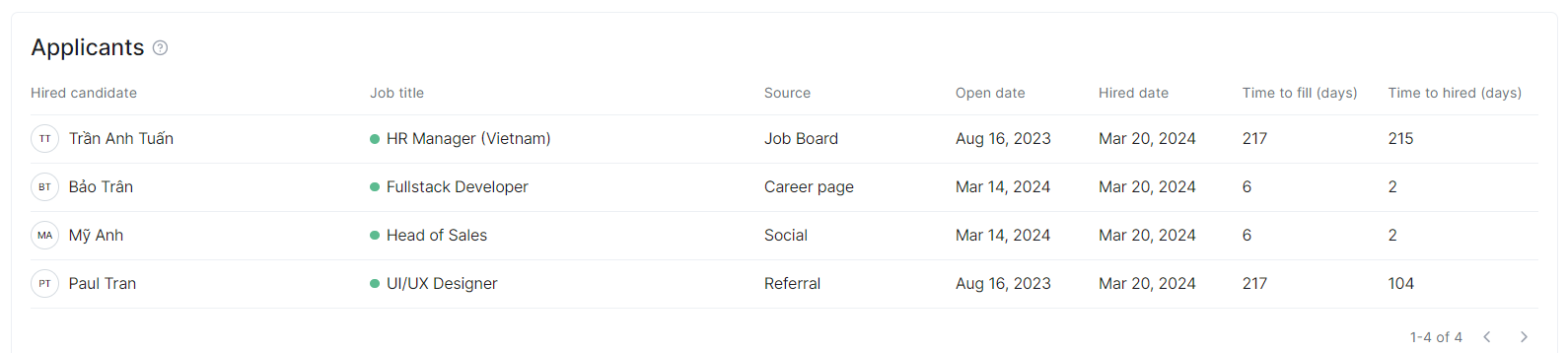
The Applicants will mention a table for candidate details that may help you get a clear overview of all applicants summarized in the above report as numeric
#### \* Note for Open Date
This date reflects the very first time the job was published (either **Published** or **Internal** status) within your company account. Even if the job was closed and reopened later, the original Open Date remains unchanged. This ensures the **Time to Fill** metric accurately captures the total time it takes to fill a position from its initial launch.