> For the complete documentation index, see [llms.txt](https://help.hireforce.io/llms.txt). Markdown versions of documentation pages are available by appending `.md` to page URLs; this page is available as [Markdown](https://help.hireforce.io/product-guides/candidate-management/candidate-processing.md).
# Candidate Processing
## Overview
The Candidate Processing flow in Hireforce follows a structured pipeline that guides candidates from initial contact to successful placement. By default, Hireforce provides a pipeline with six fixed stage types: **Sourced or Applied, Screening, Interview, Offer and Hired**.
However, Hireforce also allows for flexibility and customization:
* **Customizable Pipeline**: You can customize the pipeline to better fit your specific recruitment process by creating new stages within each stage type. This ensures that the pipeline aligns with your unique workflow.
* **Reporting and Pipeline Views**: Reports and pipeline views for both Jobs and Candidates are dynamically generated based on these stage types, providing relevant insights and tracking according to your custom process.
## Application
At this stage, the candidate's profile is added to the pipeline of a job in one of two ways:
### Sourced
The candidate is added to the database by a recruiter on Hireforce and is recorded as **Sourced**.
To source the candidate to a job, you access to an open job on Hireforce, then:
* Click the +New button to single upload.
* Click the Upload Cvs/Resume button to bulk upload.
### Applied
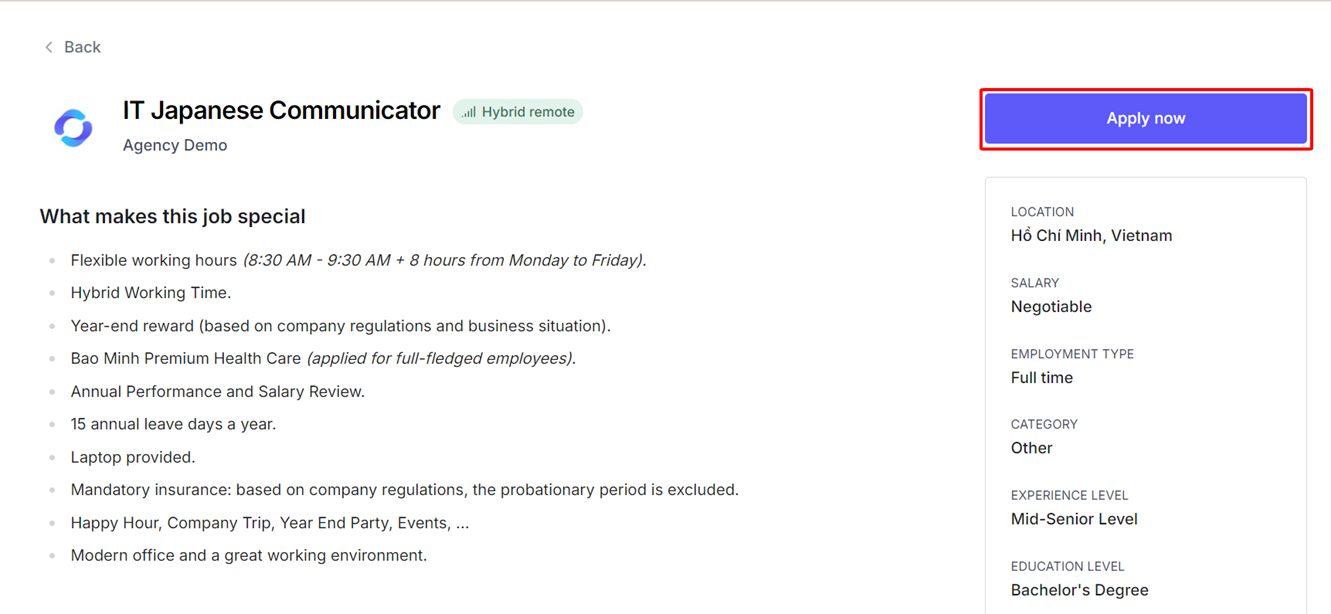
The candidate applies themselves and is recorded as **Applied.**
Candidate can apply at the Job public link.
## Active Process
Active processes include three stage types: **Screening, Interview and Offer**.
If you are an Admin or a Member (based on your user permission), you can:
* Add additional stage names within each stage type to better align with your specific process.
* You can edit or delete all of stages at Active Process, including 3 stage types.
## Hired
### Mark as hired
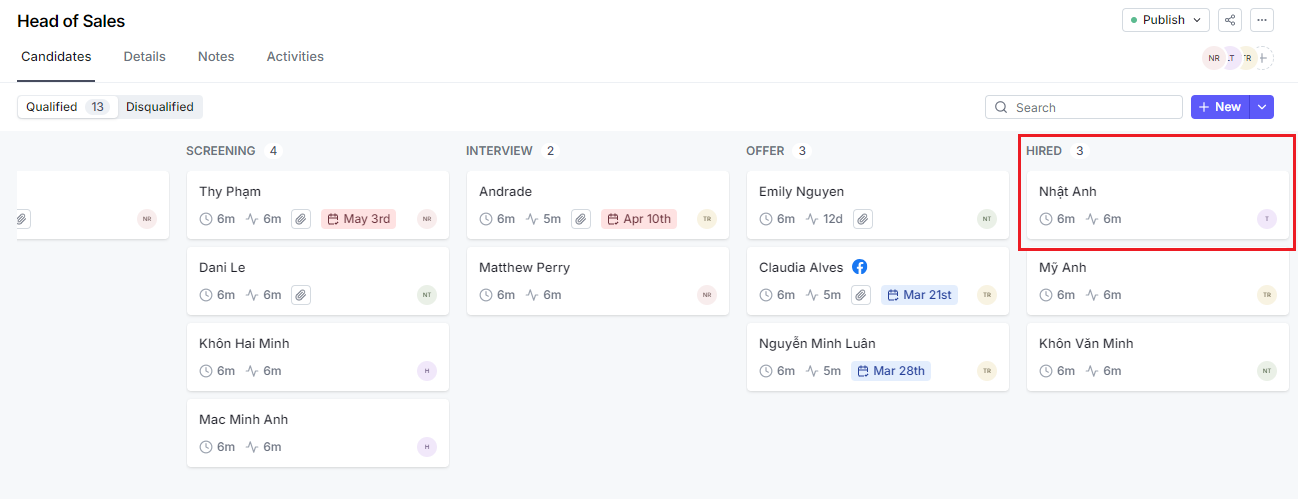
To mark a candidate as hired, move them to the **Hired** stage in the following 2 ways:
1. At the job pipeline, drag and drop the application need moving to the **Hired** stage.
2. At the candidate profile,
* On the Job-Related tab, choose the suitable Job.
* Click the **Stage Button** that shows the current stage and select **Hired.**
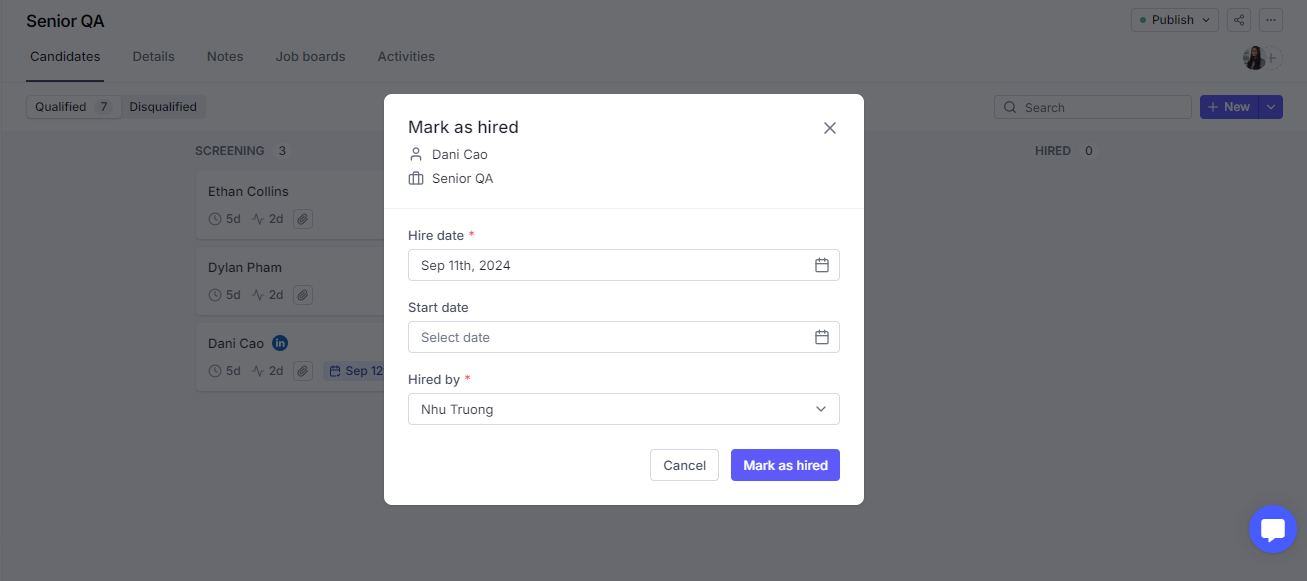
There will be a pop-up when you move the candidate to the Hired stage. You need to fill in the following information, then click **Mark as hired** to complete:
* **Hired date** is the date that the candidate has been hired.
* **Start date** is the date that the candidate starts the job.
* **Hired by** is used to determine which the user successfully filled the open job.
### Hired info
When the candidate is marked as hired, they will have a **Hired info** in their application.
It can make your team aware that the candidate is hired for a job.
Hired info includes: **Job title, Hired by and Hire date**.
## Disqualified
When you have reviewed your application, in any stage of the hiring pipeline, and decided that he/she is not fit to be hired for that position, you can disqualify that candidate, you can disqualify candidates with the appropriate [disqualification reason](/getting-started/settings/recruiting/disqualification-reasons.md).
In Hireforce, when you disqualify an application, you will have to choose a disqualifying reason. This is to prevent you from making mistakes as well as to provide insights into your candidate database.
### How to disqualify an application?
#### On The Candidate Profile
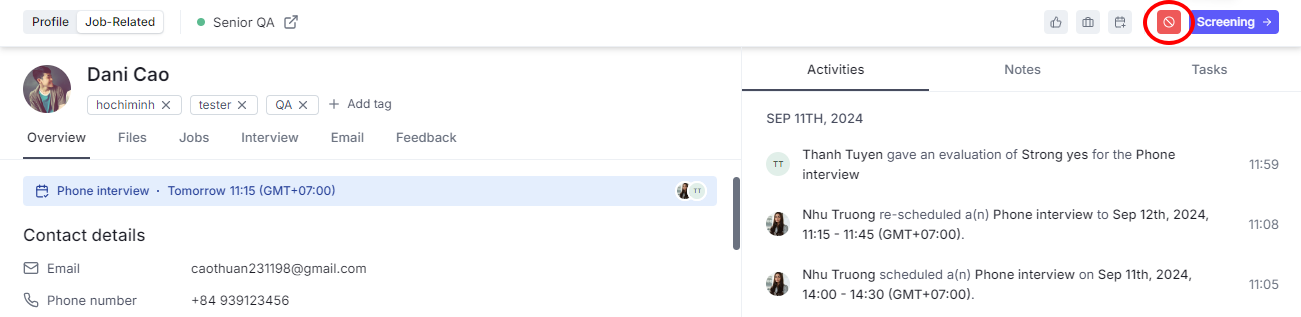
1. Open the candidate profile that you need to disqualify then go to the Job-Related tab.
2. Select the relevant job where you want to disqualify the candidate.
3. Click the **Disqualify icon**.
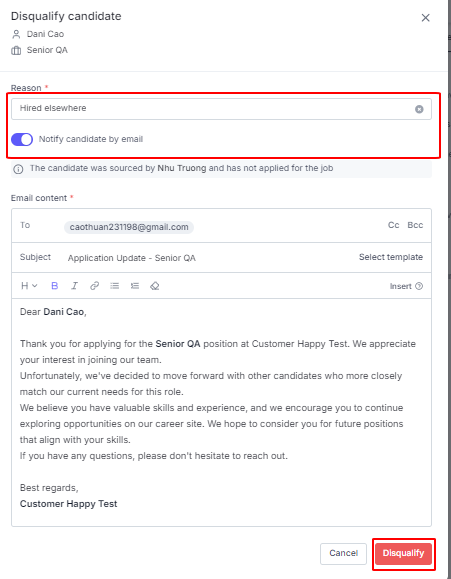
4. Select a disqualification reason from the **Reason drop-down** menu.
5. You may enable button **Notify the candidate by email** if you want to send a notification email to the Candidate. It's disable as default.
6. Click the **Disqualify** button to complete.
#### On The Job Detail Page
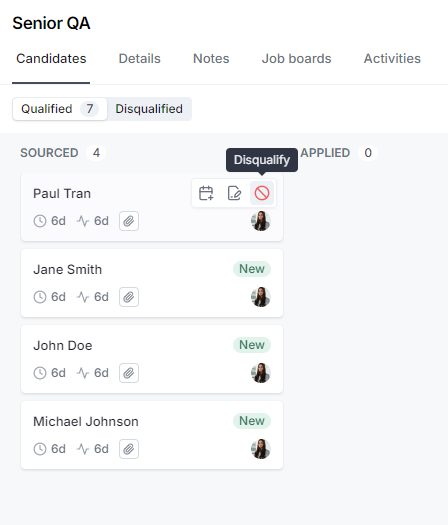
1. Hover your cursor over a candidate card that you need to disqualify.
2. Click the **Disqualify icon.**
3. Select a disqualification reason from the **Reason** drop-down menu.
4. You may enable button **Notify the candidate by email** if you want to send a notification email to the Candidate. It's disable as default.
5. Click the **Disqualify** button to complete.